English
Start a book
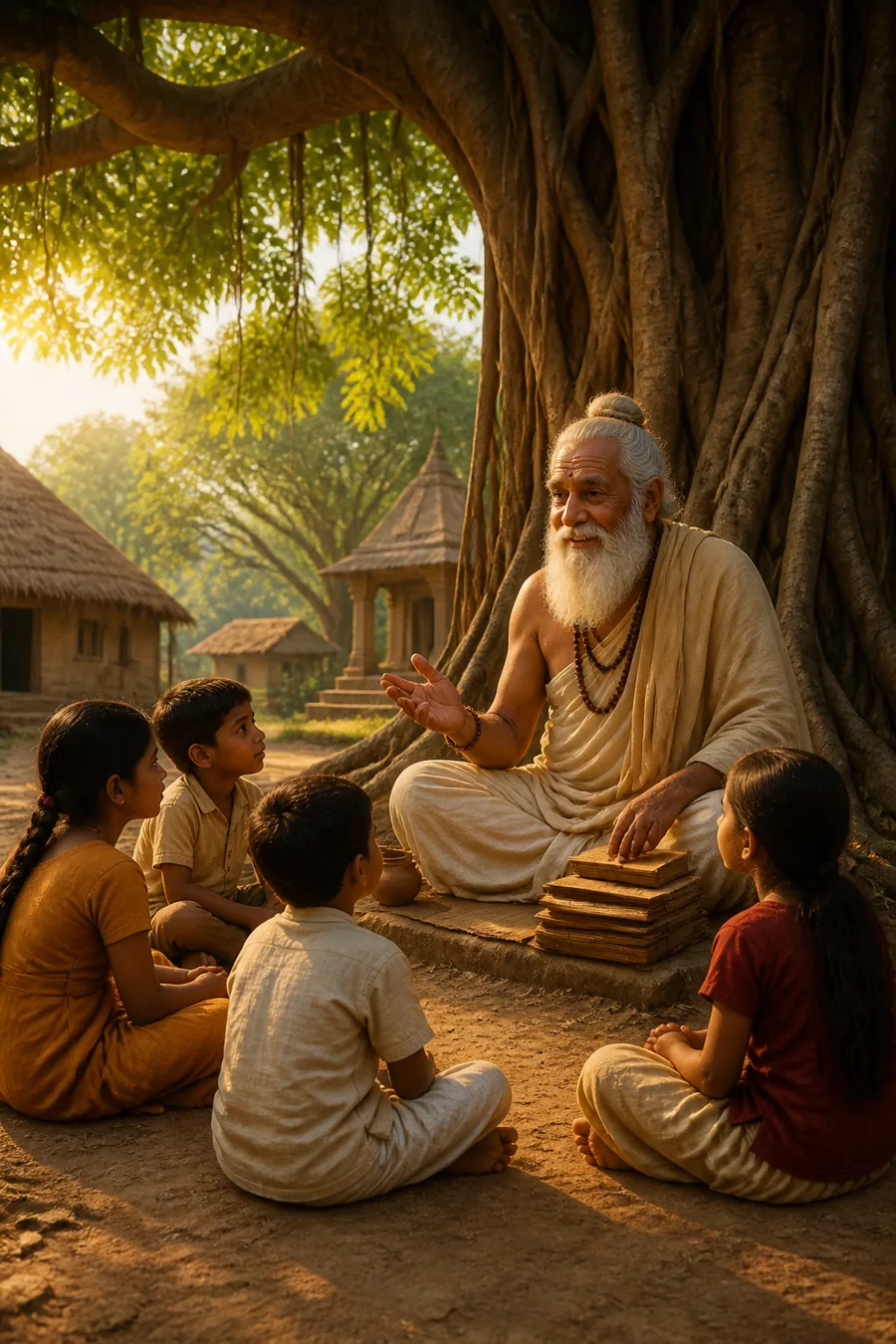
A teacher sits under a big tree while four children listen to him
Episode 1 of 8 · Meet the Vedas

What Is a Veda?

  • 1 min read
  • Ages 3–8
  • 6 pages
  • Free

Long ago there were no printed books. So how did people keep their wisest songs safe?

  1. Long, long ago, in India, there were no printed books. People wanted to keep their best songs and wisest ideas safe for the future.

  2. Wise people called rishis (say RISH-ees) watched the world and thought about it very carefully. Then they put their ideas into beautiful poems and songs.

  3. The word Veda means knowledge. The Vedas are some of the oldest writings in India. They are more than 3,000 years old.

  4. There are four Vedas: the Rigveda, the Samaveda, the Yajurveda and the Atharvaveda. In this series we will meet them all.

  5. Nobody knows exactly when each one was made, because they were spoken and sung for a very long time before they were ever written down.

  6. Children learned them by sitting near a teacher, listening and saying the words aloud, again and again, until they knew every word by heart.

The big ideaKnowledge is a treasure. We keep it safe by sharing it.
Talk about it: If you had to remember your favourite song without writing it down, what would you do?
Learn more

Facts, a quiz and words to know

Did you know?

  • The word Veda comes from the Sanskrit root vid, "to know". It is a distant cousin of English words like "wise" and "wit".
  • Each Veda has four layers. The Samhita holds the hymns and mantras. The Brahmanas explain the ceremonies. The Aranyakas are "forest texts". The Upanishads ask the big questions.
  • Scholars think most of the Rigveda was composed around 1500 to 1200 BCE, in the Punjab region. Estimates differ, and some go back even earlier.
  • The Vedas are called shruti, "what is heard". For a very long time they were spoken, heard and remembered, not written.
  • No single person wrote the Vedas. Many rishis, from many families, are remembered as the poets of the hymns, and some of them were women.
  • The Rigveda is among the oldest books in any Indo-European language, the large family that includes Sanskrit, Greek, Latin and English.

Quick quiz

  1. 1What does the word Veda mean?

    1. Story
    2. Knowledge
    3. Journey
    Show the answer

    B. Knowledge. Veda comes from vid, "to know".

  2. 2How many Vedas are there?

    1. Three
    2. Four
    3. Six
    Show the answer

    B. Four. The Rigveda, Samaveda, Yajurveda and Atharvaveda.

  3. 3Why are the Vedas called shruti?

    1. They were heard and remembered
    2. They were carved in stone
    3. They were drawn as pictures
    Show the answer

    A. They were heard and remembered. Shruti means "what is heard".

  4. 4What are the wise poets of the Vedas called?

    1. Rishis
    2. Rajas
    3. Rangolis
    Show the answer

    A. Rishis. Rishis are seers who "saw" the hymns with deep thought.

  5. 5Which Veda is the oldest?

    1. Rigveda
    2. Atharvaveda
    3. Samaveda
    Show the answer

    A. Rigveda. Scholars place the Rigveda first.

Words to know

Veda
Knowledge
Rishi
A seer, a wise poet who thinks deeply about the world
Mantra
A short sacred verse to chant or think about
Shruti
"What is heard"; another name for the Vedas
Samhita
A collection, the hymns part of a Veda
Guru
A teacher who helps us move from darkness to light

Think and do

Talk about it. What is something you know by heart? Who taught it to you, and how?

Try it. Pick a short poem or song. Say it aloud ten times with a family member listening, then say it without looking. How long did it take?

Remember: Respect for teachers, and for everything we learn.

Up next

Written for children from well-known scholarly and public sources, including UNESCO and the texts themselves. Nobody knows exactly when the Vedas were composed, so we say 'more than 3,000 years ago'. Families follow the Vedas in different ways; this series simply tells what the books are and what they say.

Rangooo

Draw and paint

Colour a drawing with a pencil, or start on a blank page. Save it or share it.