English
Start a book
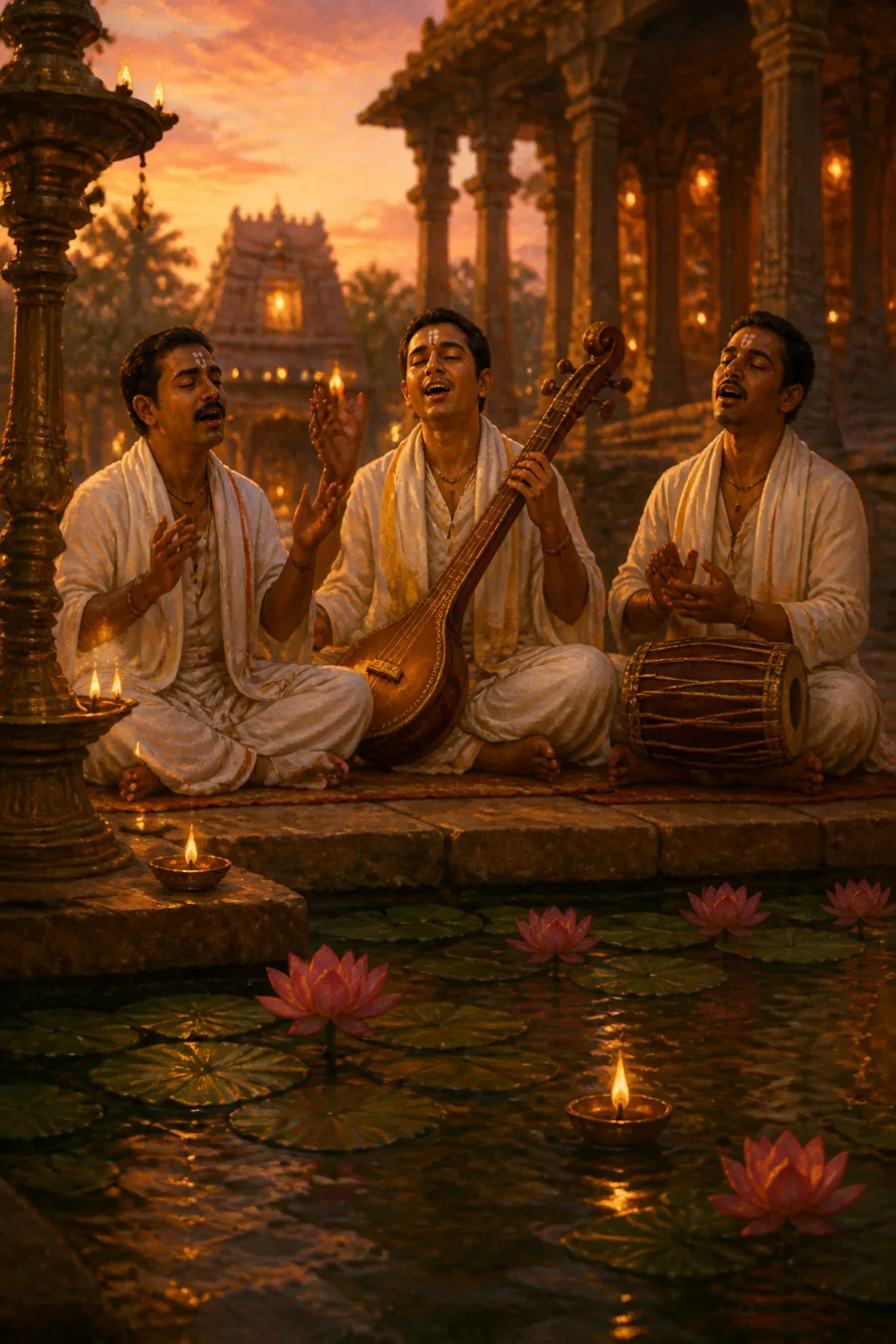
Three singers sit in a row, singing, with musical notes floating above them
Episode 4 of 8 · The Samaveda

The Samaveda: The Veda of Songs

  • 1 min read
  • Ages 3–8
  • 6 pages
  • Free

What happens when poems learn to sing? You get the Samaveda!

  1. The Samaveda is the Veda of songs. Its name comes from saman, which means a song or a melody.

  2. Most of its verses come from the Rigveda. In the Samaveda they come with tunes, like taking a poem and turning it into a song.

  3. Special singers, called udgatris, sang these songs together in big ceremonies. Some tunes were for singing aloud with others, and some were for quiet thinking.

  4. The words are stretched and lifted up and down with the tune. Little marks were written above the words, so that singers would not forget the notes.

  5. Scholars think these are some of the oldest tunes ever written down anywhere in the world!

  6. Many people say that the music of India, with its ragas and songs, has its roots in this very old singing.

The big ideaMusic brings people together and helps us remember.
Talk about it: Which song do you remember best? Why do you think songs are so easy to remember?
Learn more

Facts, a quiz and words to know

Did you know?

  • Saman means a melody. The Samaveda has about 1,549 different verses (1,875 if repeats are counted), and only about 75 of them are not found in the Rigveda.
  • The singers, called udgatris, sang in the big fire ceremonies. One of the priests, the udgatri, was in charge of the singing.
  • The chants stretch the vowels and glide up and down, so a short verse becomes a long, flowing song.
  • In some traditions the singers use finger and hand movements to remember the notes, a little like a music teacher conducting with their hands.
  • Many people see the Samaveda as the root of Indian music, because its tunes use a small set of notes that later grew into the ragas.
  • In the Bhagavad Gita, Krishna says "Among the Vedas I am the Samaveda", showing how special it was to the people who loved it.

Quick quiz

  1. 1What does saman mean?

    1. A melody
    2. A fire
    3. A river
    Show the answer

    A. A melody. Saman is a tune or song.

  2. 2What are the singers of the Samaveda called?

    1. Udgatris
    2. Rishikas
    3. Sutradhars
    Show the answer

    A. Udgatris. Udgatris sing the samans.

  3. 3Where do most verses of the Samaveda come from?

    1. The Rigveda
    2. The Ramayana
    3. The Upanishads
    Show the answer

    A. The Rigveda. Only about 75 are new.

  4. 4Which part of Indian culture is the Samaveda linked with?

    1. Cooking
    2. Music
    3. Sailing
    Show the answer

    B. Music. Many see it as an early root of Indian music.

Words to know

Saman
A melody or chant
Udgatri
The priest-singer who sings the samans
Swara
A musical note
Raga
A pattern of notes that gives a song its mood
Chant
To say words in a steady, musical way

Think and do

Talk about it. Why do you think music helps us remember things? What song do you remember best?

Try it. Take a poem you know and sing it to a new tune. Teach your tune to someone at home.

Remember: Togetherness through music.

Up next

Written for children from well-known scholarly and public sources, including UNESCO and the texts themselves. Nobody knows exactly when the Vedas were composed, so we say 'more than 3,000 years ago'. Families follow the Vedas in different ways; this series simply tells what the books are and what they say.

Rangooo

Draw and paint

Colour a drawing with a pencil, or start on a blank page. Save it or share it.