English
Start a book
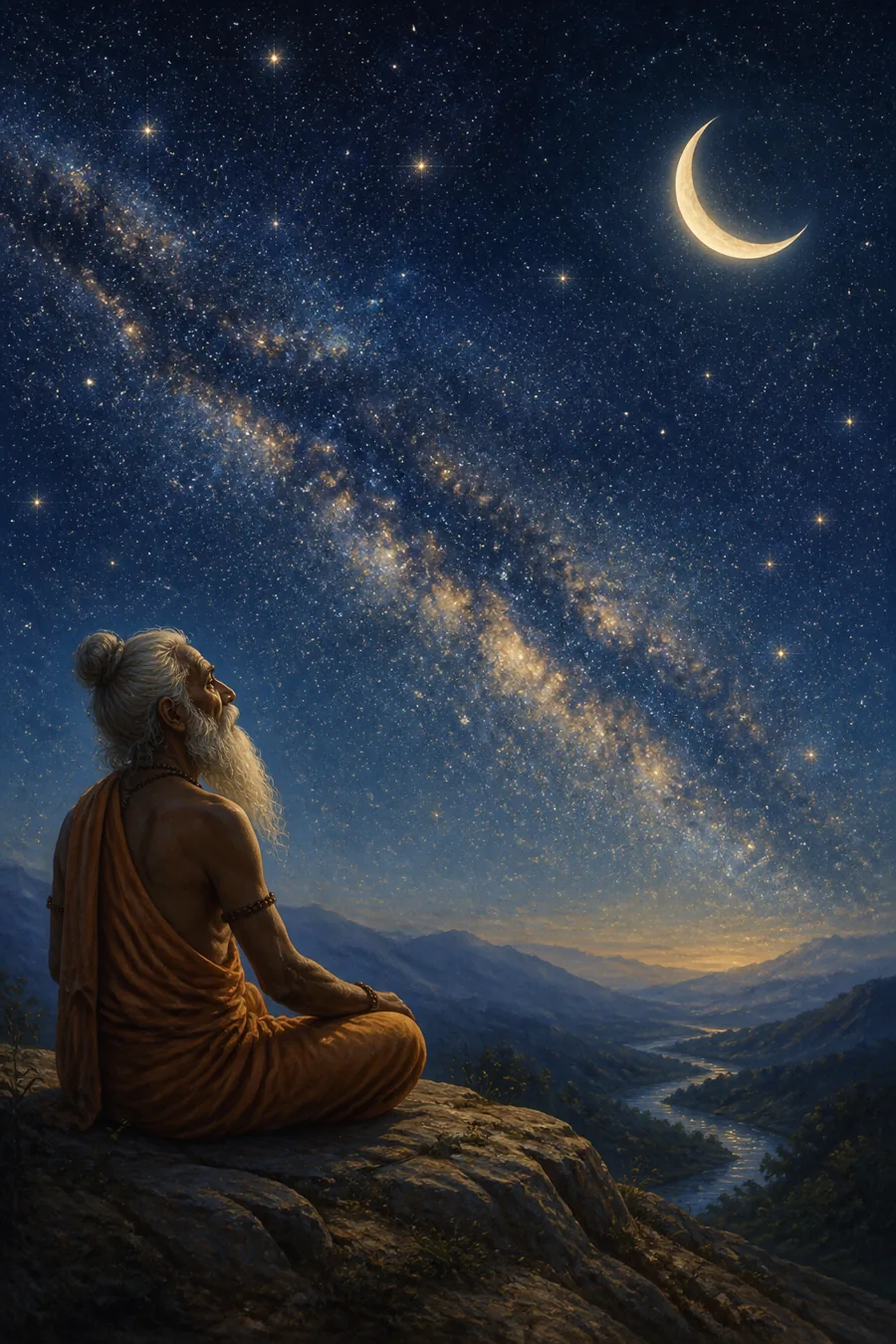
A sage looks up at a night sky full of stars and a big moon
Episode 3 of 8 · The Rigveda

The Big Question: How Did Everything Begin?

  • 1 min read
  • Ages 3–8
  • 6 pages
  • Free

A very old poem asks the biggest question of all, and ends by saying: maybe even the wisest do not know.

  1. Inside the Rigveda there is a very special poem called the Nasadiya Sukta. It is only seven verses long. People call it the Song of Creation.

  2. It asks the biggest question: how did everything begin? Before the earth and sky, before day and night, what was there?

  3. The poem says there was no day and no night. There was darkness hidden in darkness, and one thing breathing quietly, all by itself, without any wind.

  4. Then the poet asks: who really knows? Who can say where everything came from?

  5. The last verse says that the one who watches over everything from the highest heaven may know. Or maybe even he does not know!

  6. It is a poem that is happy to say, I am not sure. Many people, including the scientist Carl Sagan, have loved it for that.

The big ideaIt is fine to say 'I don't know' and keep wondering.
Talk about it: What is something you wonder about, even though nobody knows the whole answer?
Learn more

Facts, a quiz and words to know

Did you know?

  • The Nasadiya Sukta is hymn 129 in the tenth book of the Rigveda (10.129). It has only seven verses.
  • Its name comes from its first words, na asat, "not the non-existent". The poem begins: "Then there was neither existence nor non-existence."
  • The poet does not give a final answer. It ends by asking whether even the one who watches from the highest heaven really knows.
  • The astronomer Carl Sagan quoted it in his television series Cosmos, to show how long people in India have wondered about the universe.
  • The Rigveda has other creation poems too. The Purusha Sukta (10.90) pictures the world as a great cosmic being. The Hiranyagarbha Sukta (10.121) speaks of a golden seed.
  • One famous Rigveda line (1.164.46) says "Ekam sat, vipra bahudha vadanti": Truth is one, the wise call it by many names.

Quick quiz

  1. 1How many verses does the Nasadiya Sukta have?

    1. Three
    2. Seven
    3. Twenty
    Show the answer

    B. Seven. Just seven verses.

  2. 2What is another name for this poem?

    1. Song of Creation
    2. Song of the Rivers
    3. Song of the Forest
    Show the answer

    A. Song of Creation. It asks how the world began.

  3. 3How does the poem end?

    1. With a loud answer
    2. By saying maybe nobody knows
    3. With a prayer for rain
    Show the answer

    B. By saying maybe nobody knows. It leaves the question open.

  4. 4"Truth is one, the wise call it by many names" comes from which Veda?

    1. Rigveda
    2. Yajurveda
    3. Atharvaveda
    Show the answer

    A. Rigveda. Rigveda 1.164.46.

Words to know

Sat
What is; what exists and is true
Asat
What is not
Tapas
Heat or deep energy; in the poem, the power from which the one thing is born
Sukta
A hymn
Srishti
Creation

Think and do

Talk about it. The poet says "who really knows?". Is it okay not to know something? What do you do when you do not know?

Try it. Make a wonder jar. Write five big questions on slips of paper. Pick one and try to find out something about it with a grown-up.

Remember: Curiosity, and the courage to say "I do not know yet".

Up next

Written for children from well-known scholarly and public sources, including UNESCO and the texts themselves. Nobody knows exactly when the Vedas were composed, so we say 'more than 3,000 years ago'. Families follow the Vedas in different ways; this series simply tells what the books are and what they say.

Rangooo

Draw and paint

Colour a drawing with a pencil, or start on a blank page. Save it or share it.