English
Start a book
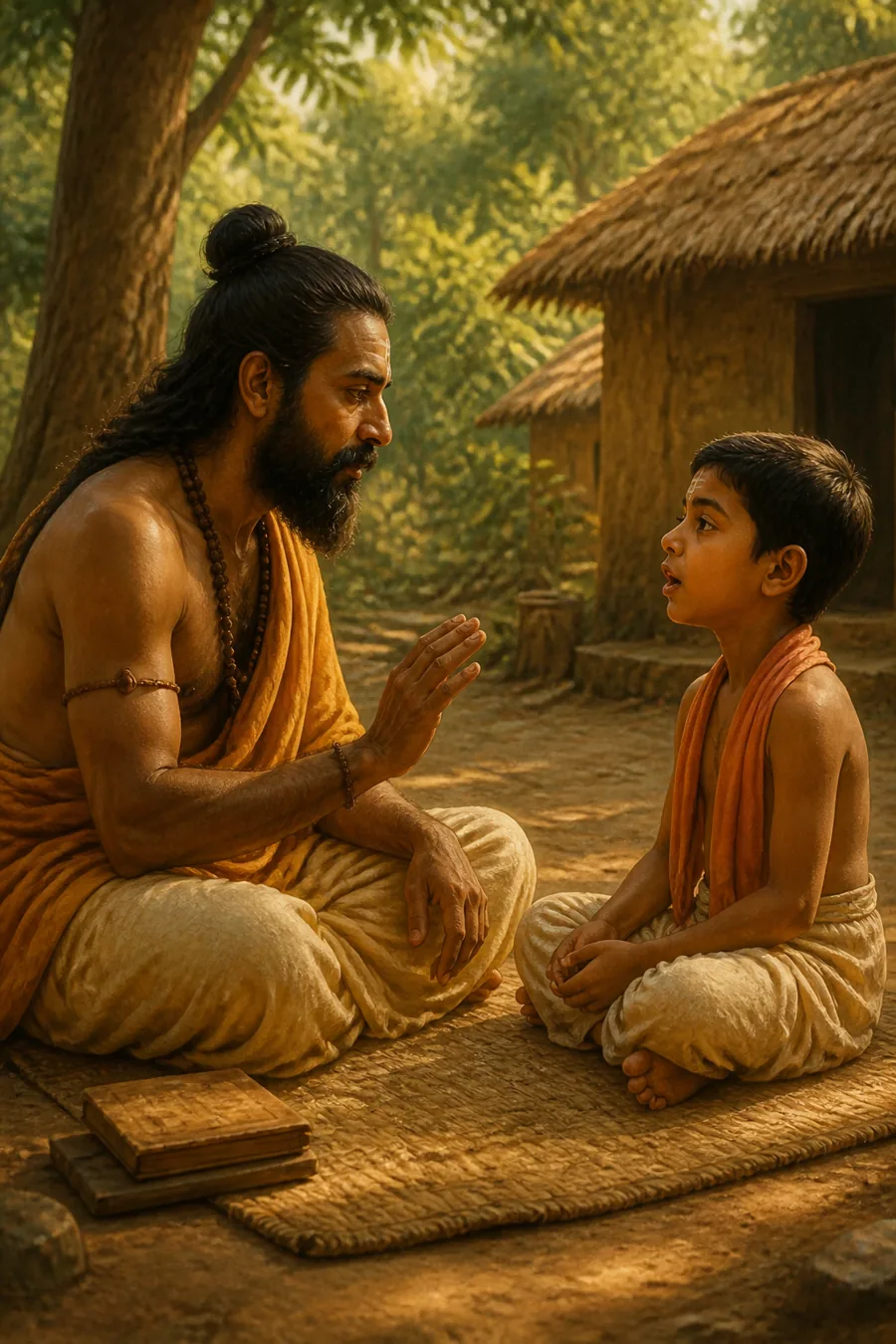
A teacher and two students sit facing each other, with wavy lines showing their chanting
Episode 6 of 8 · Learning by heart

How the Vedas Were Remembered

  • 1 min read
  • Ages 3–8
  • 6 pages
  • Free

Without books, how did students learn thousands of verses without changing a single word?

  1. For hundreds and hundreds of years the Vedas were not read from books. Students learned them by heart from a teacher.

  2. The student sat close to the teacher, listened carefully and repeated every word, again and again.

  3. To make sure that no word and no sound changed, they used clever chanting patterns. The words were said forwards and then woven back and forth, a little like braiding a plait.

  4. Because of this care, Vedic chanting has been passed from teacher to student for a very long time.

  5. In 2008, UNESCO, a group that looks after treasures of the whole world, put Vedic chanting on its list of the world's oral heritage.

  6. Today, in some places, students still learn to chant in the same way, with patience and practice.

The big ideaPatience and practice can help us do wonderful things.
Talk about it: Try saying a short rhyme five times in a row. Is it easier each time?

Learn more

Facts, a quiz and words to know

Did you know?

  • UNESCO honoured the tradition of Vedic chanting in 2003 and put it on its list of the Intangible Cultural Heritage of Humanity in 2008.
  • Vedic chanting uses three pitches: raised (udatta), lowered (anudatta) and a mix of the two (svarita). A wrong pitch can change the sound of a whole word.
  • One chanting pattern is called jata, which means a braid. Words are said in order, then woven back and forth, so a mistake would stand out at once.
  • Another pattern, ghana, means dense. A chanter who masters it is called a ghanapathi, a very high honour.
  • The Vedas have been learned this way in families for generations. Scholars have found that chanters living far apart recite almost exactly the same.
  • Of the many ancient branches of Vedic recitation, only a few have survived to today. Teachers and students work to keep them alive.

Quick quiz

  1. 1How were the Vedas passed on for hundreds of years?

    1. Printed in books
    2. Learned by heart from a teacher
    3. Sent in letters
    Show the answer

    B. Learned by heart from a teacher. Teacher to student, by voice.

  2. 2What does the chanting pattern called jata mean?

    1. A braid
    2. A river
    3. A lamp
    Show the answer

    A. A braid. The words are woven like a braid.

  3. 3Which group honoured Vedic chanting as world heritage?

    1. UNESCO
    2. NASA
    3. FIFA
    Show the answer

    A. UNESCO. UNESCO looks after treasures of the whole world.

  4. 4What do the three pitches (udatta, anudatta, svarita) help with?

    1. Keeping the sounds exact
    2. Making chants louder
    3. Choosing a dance
    Show the answer

    A. Keeping the sounds exact. They keep every word exactly right.

Words to know

Patha
A way of reciting the words in a set pattern
Jata
Braid; a chanting pattern
Ghana
Dense; a more complex chanting pattern
Udatta
A raised pitch
Kanthastha
Learned by heart, "kept in the throat"
Guru-shishya
The bond between teacher and student

Think and do

Talk about it. What helps you remember things best: songs, pictures, stories or movement?

Try it. Try the braid. Pick a four-word line. Say it forwards. Then say words 1-2, then 2-3, then 3-4, then the whole line again. Does it get easier?

Remember: Patience and practice.

Up next

Written for children from well-known scholarly and public sources, including UNESCO and the texts themselves. Nobody knows exactly when the Vedas were composed, so we say 'more than 3,000 years ago'. Families follow the Vedas in different ways; this series simply tells what the books are and what they say.

Rangooo

Draw and paint

Colour a drawing with a pencil, or start on a blank page. Save it or share it.