Kathakali comes from Kerala. It is a dance-drama, like a play in which the actors dance instead of speaking.
The stories come from the Ramayana and the Mahabharata. Singers sing the words, and the actors show every feeling with their faces, hands and eyes.
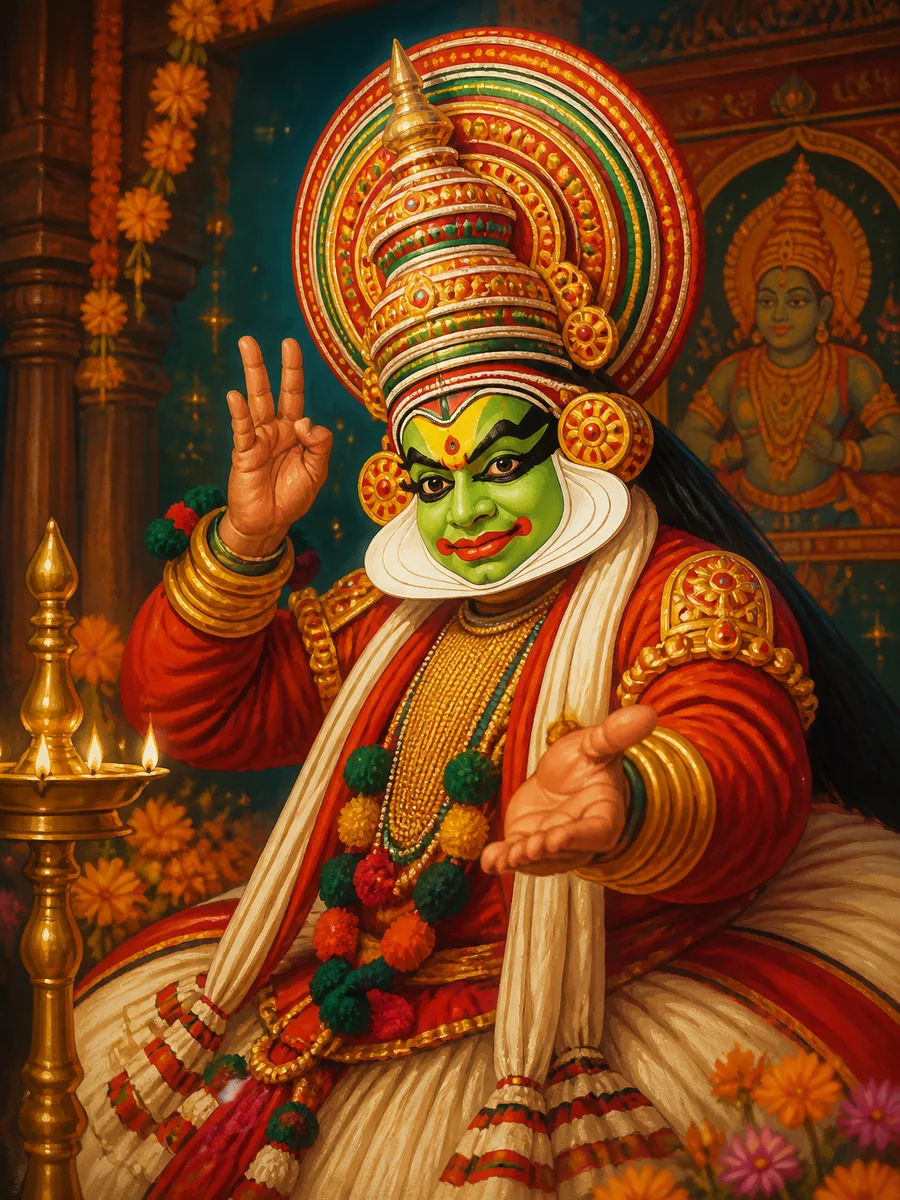
The make-up is a colour code! A green face means a noble hero. A red-streaked face means a proud, fierce villain. A soft yellow-orange face means a gentle woman or a sage.
Putting on the make-up can take hours. The actors also wear tall crowns and huge, wide skirts.
Loud drums called the chenda and the maddalam play. Traditionally, a Kathakali play lasts through the night.
Actors train for years to move their eyes and eyebrows in many ways. Look in a mirror and see how much you can say with only your eyes.

Kathakali: Painted Faces and Giant Skirts
Green faces, red faces and thundering drums: a play where nobody speaks.
Learn more
Facts, a quiz and words to knowDid you know?
- Kathakali means story-play, from katha (story) and kali (play).
- A green face is called pacha. It shows a noble hero.
- Putting on the make-up can take hours, and the actors also train their eyes and eyebrows for years.
- The stories come from the Ramayana and the Mahabharata.
Quick quiz
1What does a green face show?
- A noble hero
- A villain
- A gentle woman
Show the answer
A. A noble hero. Green, called pacha, is for noble heroes.
2Which drums play in Kathakali?
- Chenda and maddalam
- Tabla and dholak
- Mridangam and khol
Show the answer
A. Chenda and maddalam. The chenda and the maddalam are the loud drums of Kathakali.
3Do Kathakali actors speak?
- No, singers sing for them
- Yes, all the time
- Only the villains
Show the answer
A. No, singers sing for them. Singers sing the words while the actors dance and use their faces and hands.
Words to know
- Pacha
- The green face of a noble hero
- Kathi
- The red-streaked face of a proud villain
- Chenda
- A loud, tall drum played with sticks
- Maddalam
- A barrel-shaped drum played with the hands
Think and do
Talk about it. Which feeling is hardest to show with only your eyes?
Try it. Look in a mirror and show happy, sad, brave and surprised using only your eyes and eyebrows.
Remember: Noticing how others feel.
Up next
Written for children from well-known public sources, including the Sangeet Natak Akademi and UNESCO. Dates are approximate, and every dance has several schools and styles; this series tells the main ideas.